Délice Pistachios
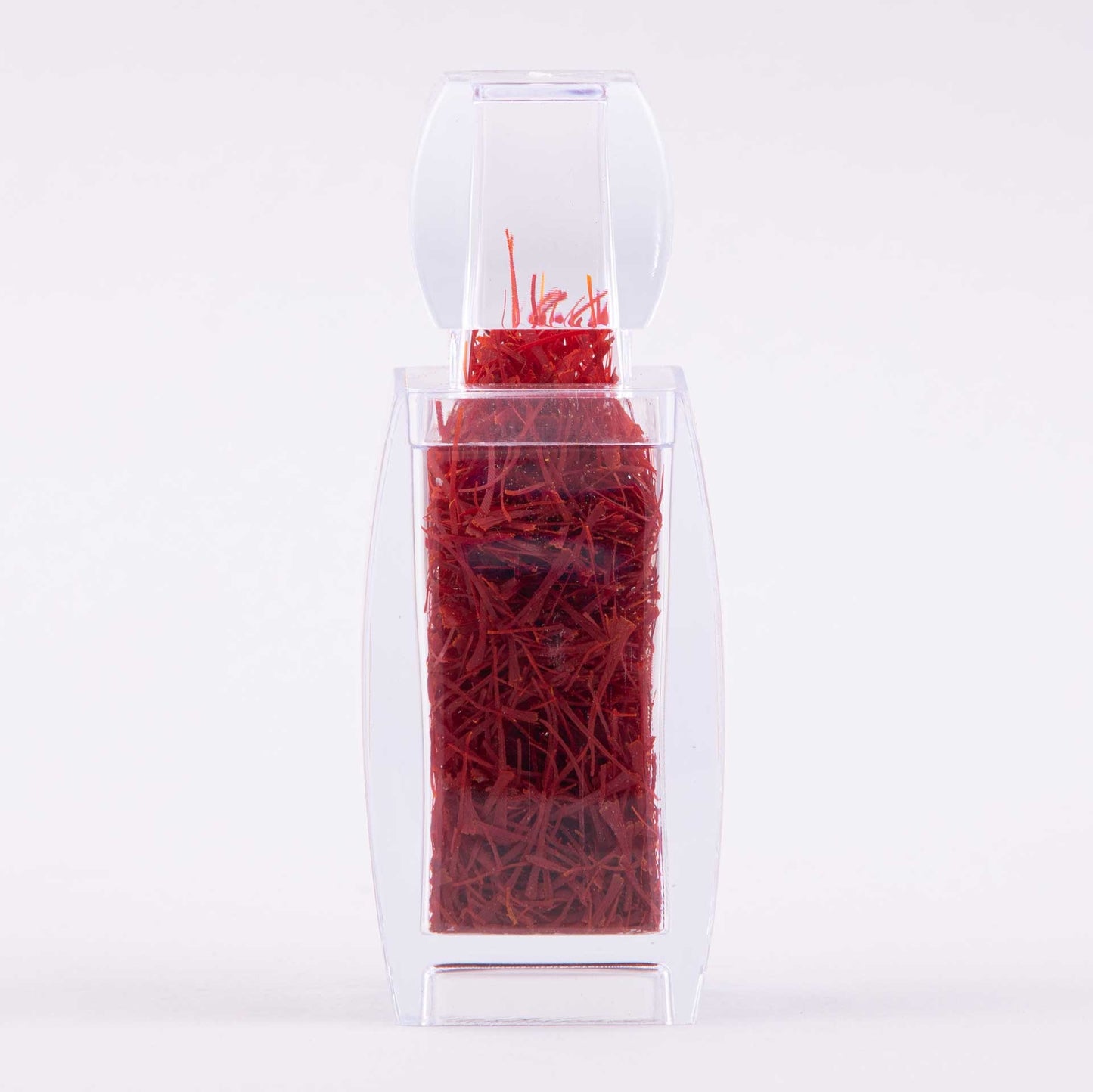
Super Negin Saffron
Super Negin Saffron
Super Negin is the top grade of Iranian saffron: whole, unbroken threads of pure red stigma, long and thick, with no yellow style attached anywhere. Nothing but the part of the flower that carries colour, aroma and flavour.
Supplied in bulk to distributors, food manufacturers, tea and spice blenders, and kitchens buying at volume.
What the grade actually means
Saffron grading is not marketing language. It describes which part of the flower is in the jar, and the difference is measurable.
- Super Negin — the longest, thickest, wholly intact all-red threads. Fewest threads per gram, highest colouring strength, highest price. This grade.
- Negin — all-red and intact, but shorter and finer than Super Negin.
- Sargol — all-red, but the threads are broken and shorter. Strong colouring, less impressive in the hand.
- Pushal — red stigma with 1–3 mm of yellow style still attached. The style adds weight and contributes nothing. Legitimate as its own grade, and routinely sold as something better.
Because Super Negin takes only the longest whole threads, more flowers go into each gram than for any other grade. That is the whole reason it costs what it does.
Specification
- Grade: Super Negin — all-red, whole threads, no style
- Origin: Khorasan
- Form: Whole threads. Not powdered.
- Composition: 100% saffron. No colouring, no additives, no filler.
- Packing: To requirement — bulk sealed units, food-service packs or retail-ready jars
How to verify saffron — ours or anyone's
Saffron is the most adulterated spice traded, and the substitutions are good enough that appearance alone will not settle it. Four checks, none of which need a laboratory:
- Cold water. Put a few threads in cold water. Real saffron releases its colour slowly, over ten to fifteen minutes, and the threads stay red. Dyed safflower or corn silk colours the water almost immediately and the threads go pale as the dye leaches out.
- Taste. Saffron is bitter, never sweet. Sweetness means it has been treated with honey or glycerine to add weight.
- Rub it. Between damp fingers, real saffron leaves a faint yellow-orange stain. A bright red stain is dye.
- Look for yellow. Any pale or white portion at the base of a thread is style, not stigma. It adds weight to the invoice and nothing to the dish.
Beyond that, the only real answer is a laboratory. ISO 3632 measures crocin for colour, picrocrocin for taste and safranal for aroma, and Category I is the top band. Ask any supplier for their figures. A supplier who cannot produce them is telling you something.
Who buys this
- Distributors and importers supplying grocery, hospitality and specialty food channels.
- Food manufacturers — confectionery, bakery, dairy, ready meals and beverage.
- Tea and spice blenders.
- Hotel and restaurant groups buying for multiple kitchens.
- Repackers and private label producing retail jars under their own brand.
Applications
Persian cooking above all — chelo and tahchin, sholeh zard, and bastani sonnati, the saffron and rose ice cream that is the dish most people meet saffron through. Beyond that: paella, risotto alla milanese, biryani and bouillabaisse; pastry work including custards, brioche, panna cotta and crème brûlée; confectionery, nougat and halva; and saffron-infused beverages, which have grown quickly as a café menu item.
With pistachio and rose it forms the three ingredients that define Persian dessert. All three are in this catalogue, and they were built to be sold together.
Using it properly
Worth passing on to your customers, because misuse is the commonest reason someone concludes saffron is not worth the money.
Never add threads dry to a dish. Grind them lightly — a pinch of sugar or salt in the mortar helps break them down — then steep in warm water, milk or stock for twenty to thirty minutes before adding. Warm, not boiling: heat above roughly 80°C drives off the aromatics you are paying for. The traditional Persian method of resting ground saffron under a slowly melting ice cube works on the same principle.
And use less than instinct suggests. Around 0.1 to 0.2 g flavours a dish for four to six. Past that, saffron turns medicinal rather than luxurious.
Freight
Saffron is the one product in our range where air freight makes straightforward commercial sense. It is high value and negligible volume, so shipping cost is a small fraction of consignment value and lead times are short — the opposite of rose buds, where the freight is charged on air and the economics need planning. For most destinations, air is the sensible route and we will quote it that way.
Requesting a quote
Pricing moves with harvest, grade and volume, so we quote rather than publish. To get a useful answer in one message, include:
- Destination country and city
- Target volume — per shipment, and annually if known
- Packing format, or tell us the channel and we will propose one
- Whether you need private label or retail-ready jars
- Shipping terms you work on
- Any documentation or testing your market requires
Questions
Why not powdered saffron?
Because powder cannot be verified by eye. Turmeric, safflower and paprika all disappear into ground saffron without trace, which is why powdered saffron is where most adulteration happens. Threads can be inspected, counted and tested. If you need powder for a production line, grind it yourself from threads you have already checked.
What is the minimum order?
It depends on packing and destination. Saffron ships in small volumes at high value, so the constraints are quite different from our bulkier lines. Tell us your target volume and we will tell you what is workable.
How long does saffron keep?
Stored airtight, dark, cool and dry, it holds well for two to three years, though colouring strength declines gradually across that time. Keep it away from light and steam, and do not refrigerate — condensation on opening does more harm than ambient storage.
Share