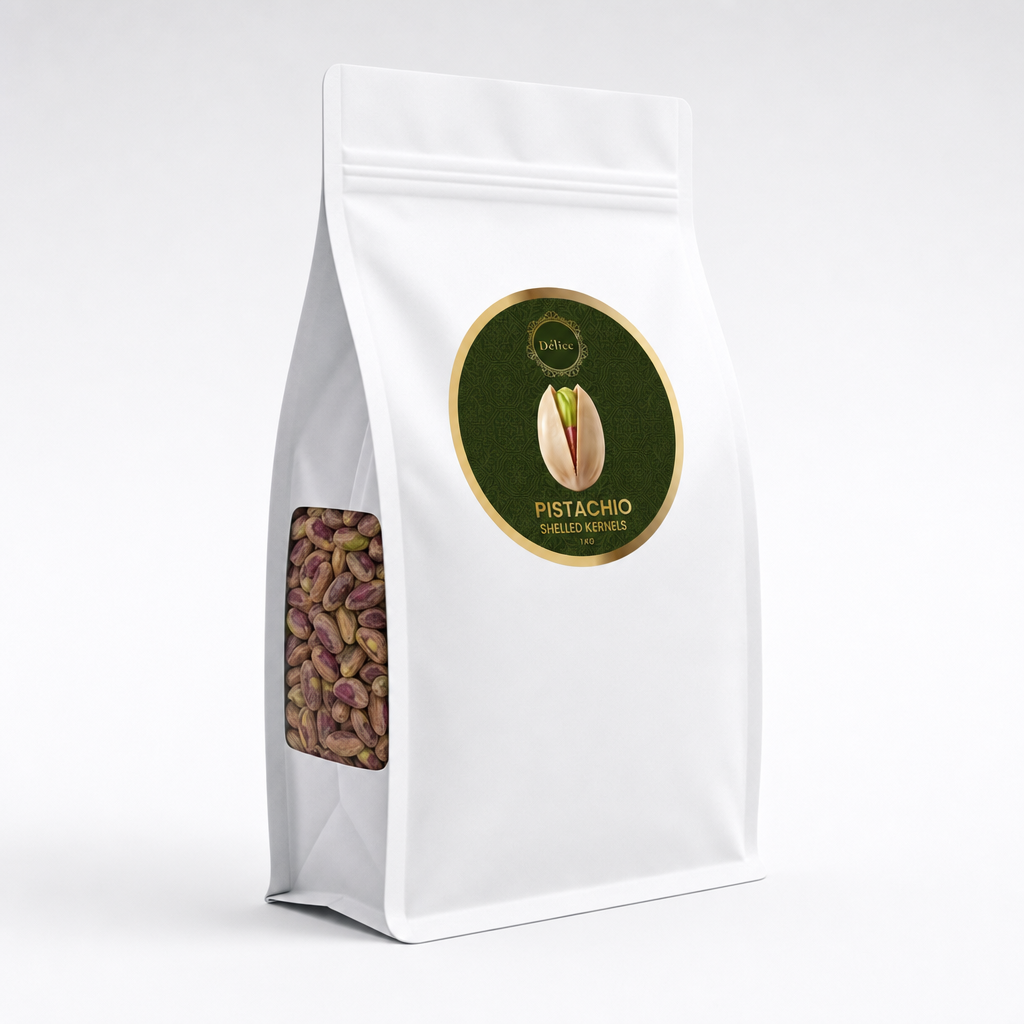
Délice Pistachios
Shelled Pistachio Kernels
Shelled Pistachio Kernels
Couldn't load pickup availability
Pistachio the way it comes out of the shell — shell removed, skin left on. That thin reddish-purple skin changes the ingredient more than people expect: deeper flavour, a tannic edge against sweetness, and the mottled purple-over-green look that a peeled kernel does not have.
Whole Iranian kernels, raw, with nothing added: no oil, no salt, no colouring.
What the skin gives you
The skin carries tannins. In a delicate white chocolate ganache that reads as a flaw, which is exactly why the peeled kernel exists. In a chocolate chip cookie, a granola, a dukkah or a roasted and salted bowl, the same astringency is doing something useful — it cuts sweetness and stops the nut tasting flat. The colour works the same way: against pale dough or dark chocolate, purple-and-green mottling is more interesting than a uniform green.
There is a cost argument too. Peeling is labour plus yield loss, so skin-on kernels are priced accordingly — MYR 40 per kilogram less than peeled, at every size. Where the skin is not a problem, you are paying less for a nut that is arguably doing more.
How to use
- Roasting and snacking. The skin is standard here and holds seasoning well.
- Rustic baking. Cookies, biscotti, granola, banana bread and rye loaves, where the crumb is dark enough that green would not show anyway.
- Savoury. Dukkah, herb crusts, pilaf, stuffings and grain salads.
- Chocolate work. Dark chocolate bars and clusters, where the skin gives contrast rather than fighting it.
- Ice cream. A speckled fold-in rather than a clean green one.
- Your own paste or butter. Grinding with the skin on gives a darker, more assertive result — a legitimate style, not a compromise.
Which size?
- 250 g. A home-kitchen pack. Five or six batches of cookies, granola or biscotti, or a good bowl of roasting nuts. If you are deciding between shelled and peeled, the cheapest way to find out which your cooking wants.
- 500 g. A dozen batches, several rounds of roasting and salting, or a steady run of savoury service. Suits weekly baking, a small café, or small-batch nut butter.
- 1 kg. A full week of production baking, a commercial roasting run, or in-house paste milling. The lowest cost per kilogram, and the size where the saving against peeled starts deciding whether a menu item works.
A note on toasting
The skin gives you more room than a peeled kernel does. Colour loss matters less when the nut is not being judged on its green, so 150–160°C for eight to ten minutes is comfortable, and you get more roasted flavour for it. Single layers rather than deep trays.
At a glance
- Origin: Iran
- Form: Whole kernels, shell removed, skin on, raw
- Size: Approximately 18–20 mm
- Ingredients: 100% pistachio kernels. Nothing added.
- Allergen: Tree nuts
- Available in: 250 g, 500 g and 1 kg
Storage
Sealed, cool, dark and dry, refrigerated once opened. Pistachio is high in unsaturated fat, which is what makes it taste the way it does and also what makes it turn in a warm cupboard. At a kilo, decant into smaller containers and work from one at a time rather than opening the whole quantity on every service.
Questions
Does "shelled" mean in the shell or out of it?
Out of it. The hard outer shell has already been removed, so there is no cracking to do — you are buying kernel weight, not shell weight, which is worth remembering when comparing against in-shell prices. The thin skin around the kernel stays on.
Shelled or peeled?
Shelled where the nut is a flavour and texture component — baking, savoury, roasting, snacking. Peeled where the green has to be visible, or the base is delicate enough that the skin's astringency would show. If the pistachio is the decoration, buy peeled. If it is an ingredient, this is usually the better nut and the better price.
Will the skin colour bleed into my batter?
Slightly, in a wet mix left standing — a faint pinkish tinge around the nuts. Invisible in most rustic bakes. In a pale sponge or a white cream, use peeled instead.
Are these raw or roasted?
Raw, which leaves the decision with you.
Share