Délice Pistachios
Damask Rose Water
Damask Rose Water
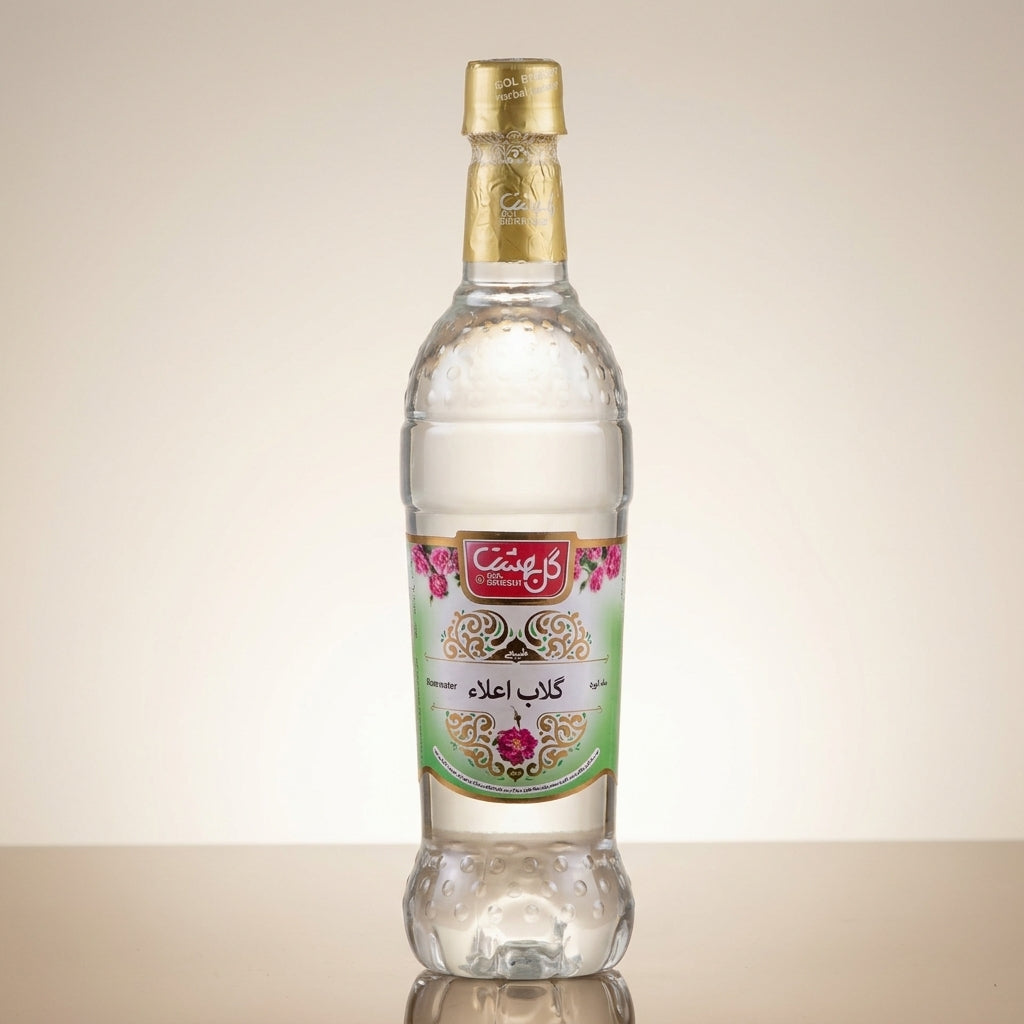
Golab — Persian rose water, distilled from the Damask rose. It is one of the oldest flavourings in continuous use anywhere, and Iran remains by far the largest producer: around 22,000 tonnes a year, with some 15,000 hectares given over to Rosa damascena for this purpose alone. Kashan has been distilling and exporting it since the sixteenth century.
This is the Gol Behesht bottling, produced in Iran for the kitchen.
How golab is made
Fresh Damask rose petals are picked at dawn during the short bloom in late spring — the golabgiri season, roughly mid-May to mid-June — and distilled with water. The essential oil separates out and what remains is the fragrant aqueous distillate. Nothing is extracted with solvent and nothing is compounded from an essence.
There is also a concentrated grade, do-atisheh — literally twice-fired — where the distillate is put back through the still in place of the water, so the second run distils rose water through roses rather than water through roses. It takes around a kilo and a half of flowers per litre and is markedly stronger. If you are used to standard golab, use roughly half as much.
How to tell real rose water from the alternative
Most of what is sold as rose water in general grocery is synthetic rose essence diluted in water. It is not dangerous, but it is not this, and the difference is easy to check.
- Taste it. Genuine golab is full-flavoured and faintly bitter on the finish. That bitterness is the single most reliable marker of the real thing. Synthetic rose is sweet or purely perfumed, with nothing behind it.
- Look at it. Clear, with no sediment and no cloudiness.
- Smell it. It should read as a flower, not as perfume, and there should be no sour edge — a sour note means it has turned.
How to use
- Persian desserts. Sholeh zard, faloodeh, bastani sonnati, ranginak and halva. With saffron and pistachio it is the flavour base of most of the repertoire.
- Middle Eastern pastry. Into the syrup for baklava, knafeh and maamoul, and through muhallebi and Turkish delight.
- Western pastry. Panna cotta, macaron buttercream, whipped cream, crème pâtissière, sponge soaks and glacé icing.
- Drinks. Rose lemonade, iced tea, sharbat, lassi and cocktails.
- Savoury. A few drops into rice, tagines and lamb, where it does what a bay leaf does — you notice its absence more than its presence.
Which size?
Rose water is used by the teaspoon, so a bottle goes further than its size suggests. Buy for how fast you will get through it rather than for the unit price — the aromatics are volatile, and a large bottle opened and closed over two years will not taste at the end as it did at the start.
- 300 ml. For a home kitchen using rose occasionally — a few desserts, the odd batch of syrup. Enough for dozens of uses.
- 700 ml. The standard Iranian household bottle, and the right size if rose water is a fixture rather than an experiment.
- 1 litre. For cafés, restaurants and anyone making sharbat, lemonade or dessert in volume, where a bottle is emptied in months rather than years.
Using it well
Rose water is the ingredient people most often ruin by generosity. Past a certain point it stops tasting floral and starts tasting like soap, and there is no rescuing a batch once it has crossed that line.
Start with a teaspoon for a domestic batch and build up by the half teaspoon. Add it late — off the heat where you can — because the aromatics that make it worth using are volatile and boil away. In anything cold or barely warm, it is at its best.
Pairs with
Pistachio and saffron above all; the three together are the foundation of Persian sweets. Also cardamom, honey, almond, raspberry, lychee, citrus and white chocolate.
At a glance
- Brand: Gol Behesht
- Product: Golab — distilled rose water
- Botanical source: Rosa damascena, the Damask or Mohammadi rose
- Origin: Iran
- Grade: Food grade, culinary
- Available in: 300 ml, 700 ml and 1 litre
Storage
Cool, dark and tightly closed. Light and heat degrade the aroma faster than anything else, so a cupboard beats a windowsill and glass beats plastic for anything you intend to keep. Once opened, keep the cap on between uses — the compounds you are paying for are volatile, and an open bottle loses them to the air. Refrigeration is not required but does extend the aroma.
Questions
Is this the same as the rose water sold for skincare?
No. This is a food product, made and packed as a culinary ingredient. Cosmetic rose water is a different product with different formulation and testing behind it, and we do not sell this one for use on skin.
Why is there a slight bitterness?
Because it is real. Genuine golab carries a faint bitterness on the finish, and it is the clearest way to tell it from synthetic rose essence in water, which tastes sweet or simply of perfume.
How much should I use?
Less than you think. A teaspoon into a domestic batch, then build. Rose becomes soapy very quickly and there is no way back from it.
What is the difference between rose water and rose essence?
Rose water is a distillate of the actual flower. Rose essence is a compounded flavouring, usually synthetic, diluted in water or alcohol. They behave differently and taste different, and essence is generally much stronger and much flatter.
Rose water or dried rose petals?
Different jobs. Rose water carries flavour through a liquid or a batter. Dried petals sit on top and give colour and texture. Our Dried Damask Rose Petals come from Tabriz and do the second job.
Share