Délice Pistachios
Pistachio Paste
Pistachio Paste
Couldn't load pickup availability
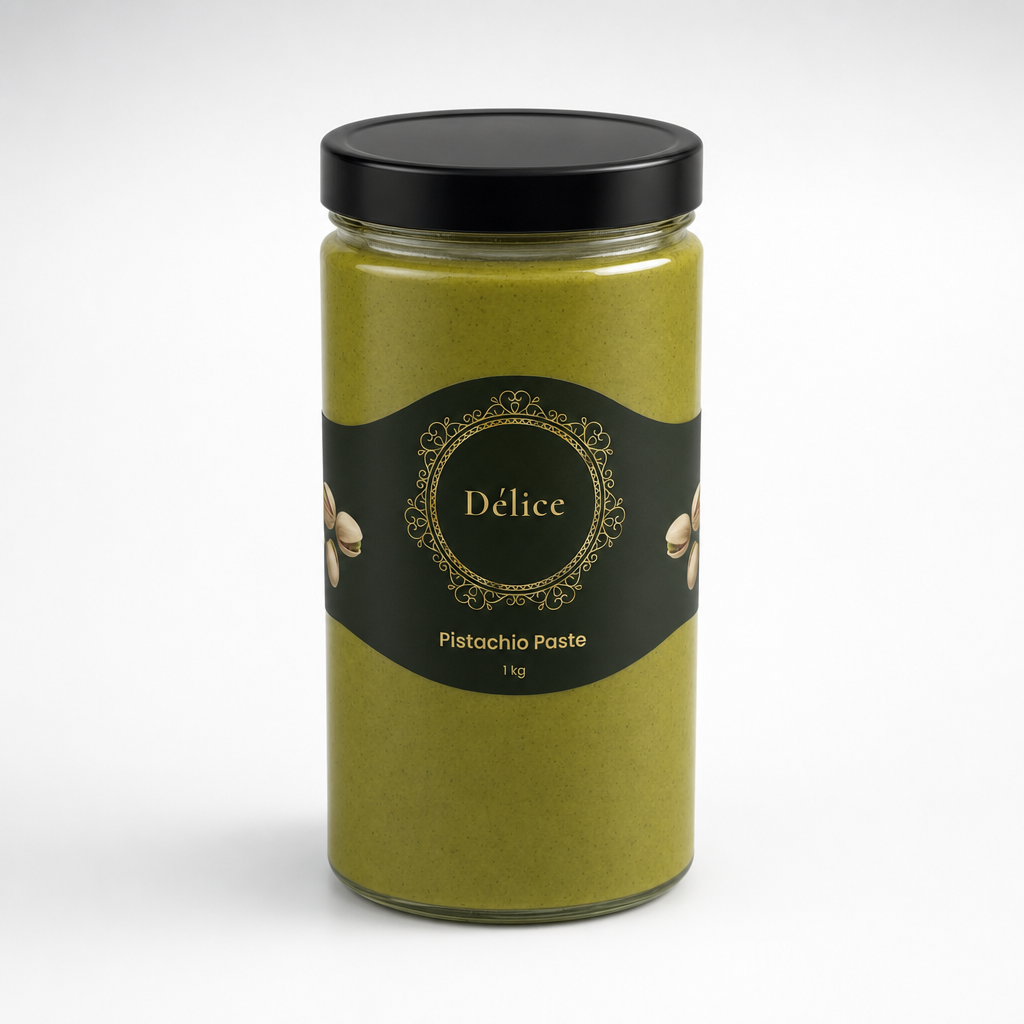
Iranian pistachio kernels ground to a smooth paste. No sugar, no added oil, no colouring, no emulsifier — pistachio and nothing else, which is rarer in this category than it should be.
The colour question, answered honestly
This paste is a natural green, somewhere between olive and soft moss depending on the harvest. It is not the electric green you see in most pistachio desserts. That colour comes from added colouring, or from paste cut with almond and dyed to compensate. If a supplier's paste is brilliantly, uniformly green across every batch, something in the jar is doing that work, and it is not the nut.
What you get instead is the flavour at full strength, and a colour that shifts a little between batches because the crop does. If your finished product needs to look greener, colour it deliberately at your end — that way you know exactly what is in it.
Separation is normal
Natural oil rises to the top in a paste with no emulsifier holding it down. That is the signature of a pure product, not a defect. Stir it back through thoroughly before each use — right to the bottom of the jar, since the solids compact underneath. At a kilo the separated layer looks alarming and is not; it just needs more effort than a small jar does.
How to use
- Gelato and ice cream. Typically 6–10% of the base weight. Start at the lower end; a pure paste carries further than a sweetened one.
- Ganache and cremeux. Blend into warm cream before combining with chocolate. Pairs particularly well with white and milk chocolate.
- Buttercream and mousse. Around 15–25% of the finished weight, adjusted to taste.
- Crème pâtissière and diplomat. Whisk in at the end while still warm.
- Bonbon fillings and spreads. Use as it is, or sweeten and loosen to your own recipe.
- Viennoiserie. Pistachio cream for croissants, escargots and babka.
Which size?
At an 8% gelato dosage, roughly: 250 g makes three litres, 500 g makes six, 1 kg makes twelve. For buttercream at 20%, a 250 g jar flavours about a kilo.
- 250 g. Enough to run several recipes and find your own dosage rather than trusting someone else's. The sensible first order.
- 500 g. A fortnight of steady use. Suits a small gelateria, a café with a pistachio item running permanently, or a baker taking regular orders.
- 1 kg. For gelaterias, patisseries and hotel pastry sections running pistachio continuously. Paste is usually the most expensive ingredient in a pistachio dessert, so this is often the size that decides whether the item stays on the menu.
Working notes
Because there is no sugar in it, dosage is not the same as a commercial sweetened paste — you will usually need less for the same flavour, and you need to account for the sugar you are no longer adding by proxy. Warming the paste slightly makes it far easier to incorporate.
At a glance
- Origin: Iran
- Form: Smooth ground paste
- Ingredients: 100% pistachio kernels. Nothing added.
- Allergen: Tree nuts
- Packaging: Glass jar
- Available in: 250 g, 500 g and 1 kg
Storage
Cool, dark and sealed. Refrigerate after opening. Cold paste stiffens considerably — bring it to room temperature or warm it gently before use rather than trying to force it cold. Always use a clean, dry spoon; water introduced into the jar is what spoils a paste early, and at a kilo that mistake costs more.
Questions
Can I use this in place of a sweetened pistachio paste?
Yes, with adjustment. You are adding pure nut rather than nut and sugar, so recalculate the sugar in your recipe and expect a stronger pistachio flavour at the same dosage.
How does the cost compare to sweetened paste?
Per kilogram it looks higher. Per unit of pistachio flavour it usually is not, because you are buying nut rather than nut and sugar, and dosing lower as a result. Run the comparison on your own recipe before deciding.
Why does mine look different from the photo?
Natural variation. Colour and consistency shift with harvest and roast, and the only way to stop that happening is to add something. We would rather show you the real thing.
Is it smooth or does it have texture?
Smooth, with the very slight body that a pure nut paste keeps. It is not a grainy butter and not a runny syrup.
Share