Délice Pistachios
Peeled Pistachio Kernels
Peeled Pistachio Kernels
Couldn't load pickup availability
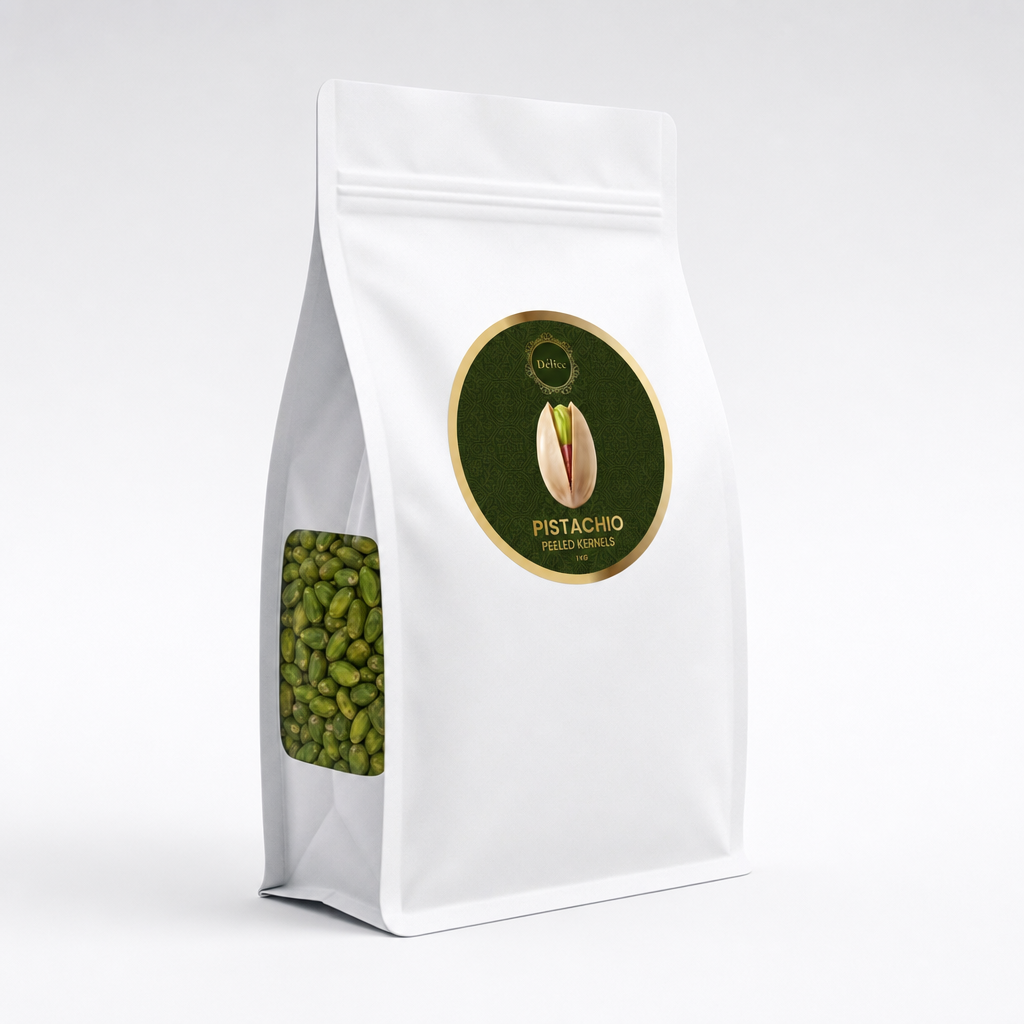
Whole Iranian pistachio kernels with the skin taken off. That single step is what separates these from the kernels most kitchens are working with: the thin purple-brown skin is removed, and what is left is the clean, vivid green that people expect pistachio to look like on a finished plate.
Raw, with nothing added — no oil, no salt, no colouring.
Why peeled
Taking the skin off changes two things. The colour holds — a skin-on kernel turns dull and brownish once it is cut or baked into something pale, where a peeled one stays green. And the faint astringency the skin carries disappears, which matters in delicate bases: white chocolate ganache, milk gelato, light creams.
That astringency is not a fault, and in a cookie or a dukkah it is an asset — which is why we sell shelled kernels with the skin on as well. The question is what the nut is doing. If it is the decoration, buy peeled. If it is an ingredient, shelled is usually the better nut and the better price.
Character
Sweet and buttery, with the resinous, almost floral note that distinguishes Iranian pistachio from other origins. Firm bite. Kernels average 18–20 mm, with natural variation in size and shade between harvests.
How to use
- Whole-nut work. Nougat, torrone, baklava layers, chocolate bars, dragées and brittle.
- Garnish and plating. Where the nut is visible and needs to look like the best version of itself.
- Ice cream and gelato. Fold in whole or roughly broken for texture against a smooth base.
- Your own cut. Chop, sliver or blitz to a house standard when a bought grade will not do.
- Savoury. Persian rice dishes, stuffings, grain salads, dukkah and crusts for lamb or fish.
Which size?
- 250 g. A home-kitchen pack — around thirty to forty garnished desserts, or one substantial project such as a tray of baklava or a batch of nougat.
- 500 g. Sixty to eighty garnished desserts, or two to three full projects. Suits a serious home baker, a small café, or pistachio as a regular fixture rather than a seasonal special.
- 1 kg. Around 120 to 160 garnished plates, or several production runs. The lowest cost per kilogram, and one seal to manage instead of four.
A note on toasting
Pistachio browns faster than almond and loses its colour as it does. If you want the green, keep it light — 140–150°C for six to eight minutes — or skip it. If you want the roasted flavour and colour matters less, go further, but know you are trading one for the other.
At a glance
- Origin: Iran
- Form: Whole kernels, skin removed, raw
- Size: Approximately 18–20 mm
- Ingredients: 100% pistachio kernels. Nothing added.
- Allergen: Tree nuts
- Available in: 250 g, 500 g and 1 kg
Storage
Sealed, cool, dark and dry. Pistachio is high in unsaturated fat, which is what makes it taste the way it does and also what makes it go off if it is treated carelessly. In a Malaysian kitchen, refrigerate once opened. At a kilo, decant into smaller containers so the working portion is the only one being opened.
Questions
Why is the colour not identical to my last order?
Because nothing has been added to make it so. Pistachio colour shifts with harvest, region and season. A perfectly uniform green across every batch is a sign of dye, not quality.
Are these raw or roasted?
Raw. That leaves the decision with you — most pastry applications are better served by an unroasted kernel.
Should I buy kernels or a cut grade?
Kernels if you want control, or if the whole nut is the point. Slivers, granules or powder if you would rather not spend labour hours on consistency you can buy already done.
Do you supply above 1 kg?
Yes. For wholesale and standing supply, contact us directly — bulk is handled separately from the retail range.
Share